
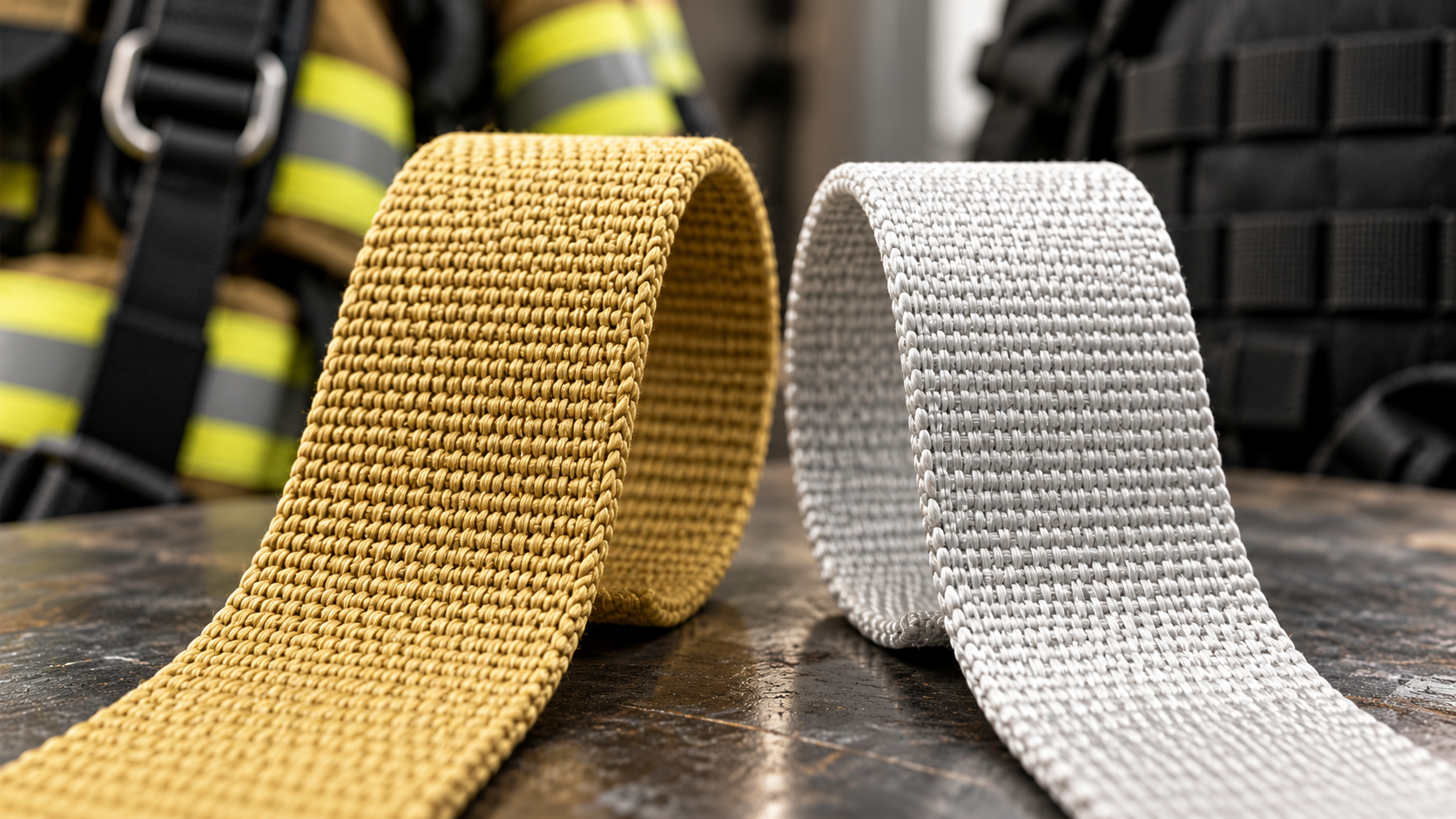
Choosing the right fibre is one of the most important decisions when specifying technical webbing. Aramid and ultra-high-molecular-weight polyethylene (UHMWPE) both offer exceptional mechanical properties, but their performance differs significantly under heat, sustained loads and environmental exposure. Understanding these differences helps engineers and manufacturers select a woven construction that meets the demands of its intended application.
Understanding Aramid and UHMWPE Webbing
Manufacturers use aramid fibres in demanding applications where strength, dimensional stability and heat resistance matter. They fall into two main groups: para-aramids, including Kevlar and Twaron, and meta-aramids, such as Nomex. Engineers typically select para-aramid fibres for their high tensile strength and stiffness, while meta-aramids offer valuable thermal and flame-resistant properties.
UHMWPE belongs to a different class of high-performance fibres and offers outstanding strength relative to weight. Fibres such as Dyneema offer very low density, low moisture absorption and excellent tensile properties. These characteristics make UHMWPE attractive for lightweight load-bearing equipment, marine applications and specialist industrial products.
Manufacturers can weave both materials into high-performance webbing, although suitability depends on more than the properties of the individual yarns.
Strength-to-Weight Ratio and Elongation
Where reducing component weight is a priority, UHMWPE offers a significant advantage. Its exceptionally low density allows manufacturers to develop lightweight woven structures without necessarily sacrificing tensile performance. This can be valuable in equipment where every additional gram affects handling, comfort or overall system weight.
Para-aramid fibres also provide excellent strength-to-weight performance, often combined with high stiffness and relatively low elongation. However, the behaviour of the finished webbing depends on yarn selection, weave construction and the way the material responds under load.
Two webbings manufactured from different fibres may achieve similar breaking strengths while displaying different weights, thicknesses and extension characteristics. Engineers should therefore compare finished constructions against the same performance requirements rather than relying on fibre strength figures alone.
Heat Resistance and Environmental Performance
Temperature is one of the clearest differences between aramid and UHMWPE webbing. Para-aramid fibres retain useful mechanical properties at temperatures that can compromise polyethylene fibres. Unlike UHMWPE, they do not melt in the conventional sense, making them an important option for applications involving elevated temperatures.
UHMWPE has a lower thermal tolerance, so manufacturers must consider both the operating temperature and the duration of exposure. This is particularly relevant where webbing remains under tension or experiences frictional heating around hardware.
Environmental conditions also influence material selection. UHMWPE absorbs very little water and offers useful resistance to many chemicals, making it attractive for wet and marine environments. Aramid fibres can be sensitive to prolonged ultraviolet exposure, although suitable constructions and protective coverings can help manage this limitation.
Engineers should assess the complete operating conditions rather than selecting either material on a single environmental property.
Creep, Abrasion and Long-Term Performance
Initial tensile strength does not tell the full story of how technical webbing will perform throughout its service life. Creep, which describes gradual deformation under sustained load, becomes particularly important where a component must maintain its dimensions over time.
Para-aramid fibres generally offer strong resistance to creep, making them suitable candidates for applications requiring long-term dimensional stability. UHMWPE performance varies between fibre grades, and manufacturers have developed specialised grades to reduce creep under sustained loading.
Abrasion resistance, repeated flexing and contact with buckles or other hardware introduce further considerations. The fibre itself influences these properties, but weave structure, thickness, surface characteristics and finishing also play important roles.
For safety-critical applications, manufacturers must establish how the finished webbing performs under representative conditions. Engineers should assess breaking strength, elongation, abrasion resistance and long-term durability against the intended specification.
Choosing the Right Webbing for Your Application
There is no universal answer to whether aramid or UHMWPE is the better material. Para-aramid may be the more suitable starting point where heat resistance and dimensional stability are essential. UHMWPE may offer greater advantages where low weight, high strength and moisture resistance are the principal requirements.
The final decision depends on how these properties interact with the product design. Width, thickness, weave construction, loading conditions and environmental exposure can all influence the performance of the finished component.
At M. Wright & Sons, we manufacture specialist narrow woven fabrics using high-performance fibres including aramids and UHMWPE. Our experience in technical weaving allows us to work with customers to develop constructions around specific mechanical and environmental requirements.
For engineers, OEMs and equipment manufacturers considering specialist webbing, early discussion of the intended application and performance criteria can help identify the most appropriate fibre and woven construction.