
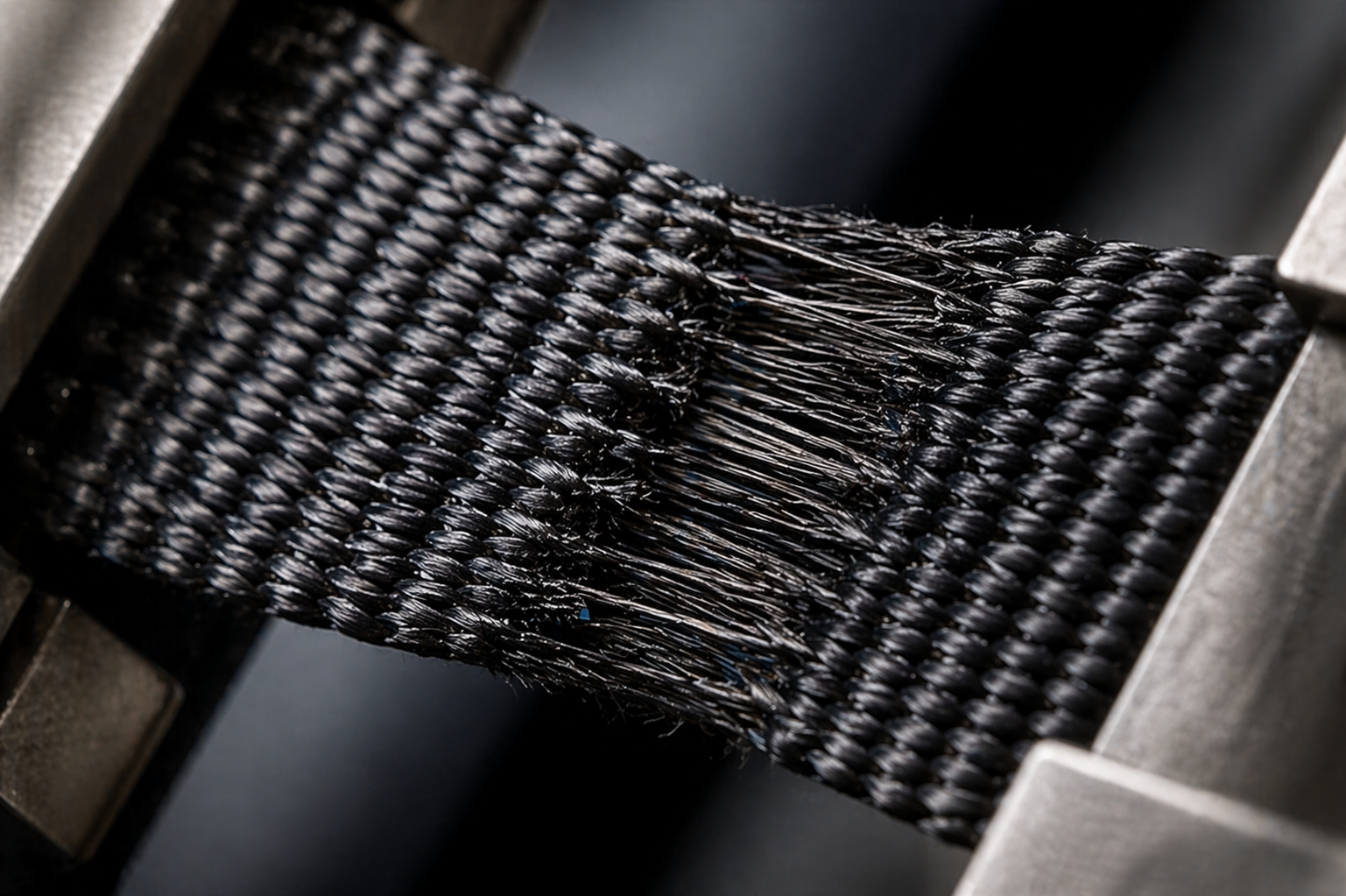
Interest in UK manufacturing has risen sharply over the past year. Advanced manufacturing also remains a major focus for investment, innovation and industrial growth. The UK Government’s Advanced Manufacturing Sector Plan aims to nearly double annual business investment across aerospace, automotive, advanced materials and space. For manufacturers supplying safety-critical markets, however, capability is not defined by production volume alone. When webbing forms part of a harness, restraint system, aircraft component or military assembly, performance depends on more than simple breaking strength.
Tensile strength is only the starting point
High tensile strength is essential in many load-bearing applications, but manufacturers must also consider how webbing behaves under load. Controlled elongation can be equally important. Excessive stretch may compromise function or positioning. In some applications, controlled extension can also help manage dynamic loading. The required balance depends on the intended use, surrounding assembly and relevant performance specification. M. Wright & Sons manufactures high-performance woven webbing for load-bearing and safety-critical applications. Constructions can be engineered around tensile strength, elongation, abrasion resistance and long-term durability.
Fibre selection affects performance
The choice of yarn has a major influence on how technical webbing performs. High-tenacity polyester and nylon can provide strong, durable and consistent constructions. More specialised fibres, including aramids and UHMWPE, may be selected where heat resistance, reduced weight or environmental resistance become important. No single fibre suits every application. A technical webbing manufacturer must consider the complete performance requirement rather than selecting material on strength alone.
Weave construction matters
Yarn is only one part of the design. Webbing performance also depends on warp and weft construction, yarn density, thickness, width and fibre arrangement. These variables influence load distribution and behaviour during repeated use. They also matter when the webbing must interact with buckles, fittings, stitched assemblies or other hardware.
Abrasion and long-term durability
Webbing can meet its initial tensile requirement and still be unsuitable if it degrades too quickly in service. Repeated movement against hardware, exposure to rough surfaces and long-term flexing can all affect performance. Abrasion resistance therefore becomes important in demanding industrial, aerospace, defence and safety applications. Finishing processes can also influence handling, durability, appearance or environmental performance, depending on the specification.
Consistency, testing and traceability
For safety-critical applications, producing one successful sample is not enough. Manufacturers need repeatable performance from batch to batch and clear control throughout production. M. Wright & Sons operates an integrated manufacturing process covering yarn processing, weaving, dyeing, finishing, tensile testing and quality assurance. This supports consistency and traceability throughout manufacture. These controls become increasingly important as UK advanced manufacturing develops across aerospace, automotive, defence and other high-performance industries.
Matching webbing to the application
Whether the requirement is aerospace, defence, industrial safety, fall protection or medical, suitable webbing starts with understanding the operating environment. Strength matters, but so do elongation, abrasion, fibre selection, weave construction, finishing, testing and repeatability. M. Wright & Sons has manufactured specialist narrow woven fabrics since 1860. We work with customers to develop webbing around specific mechanical and environmental requirements. If you are developing a safety-critical or load-bearing application, speak to our technical team about the performance your webbing needs to deliver.