
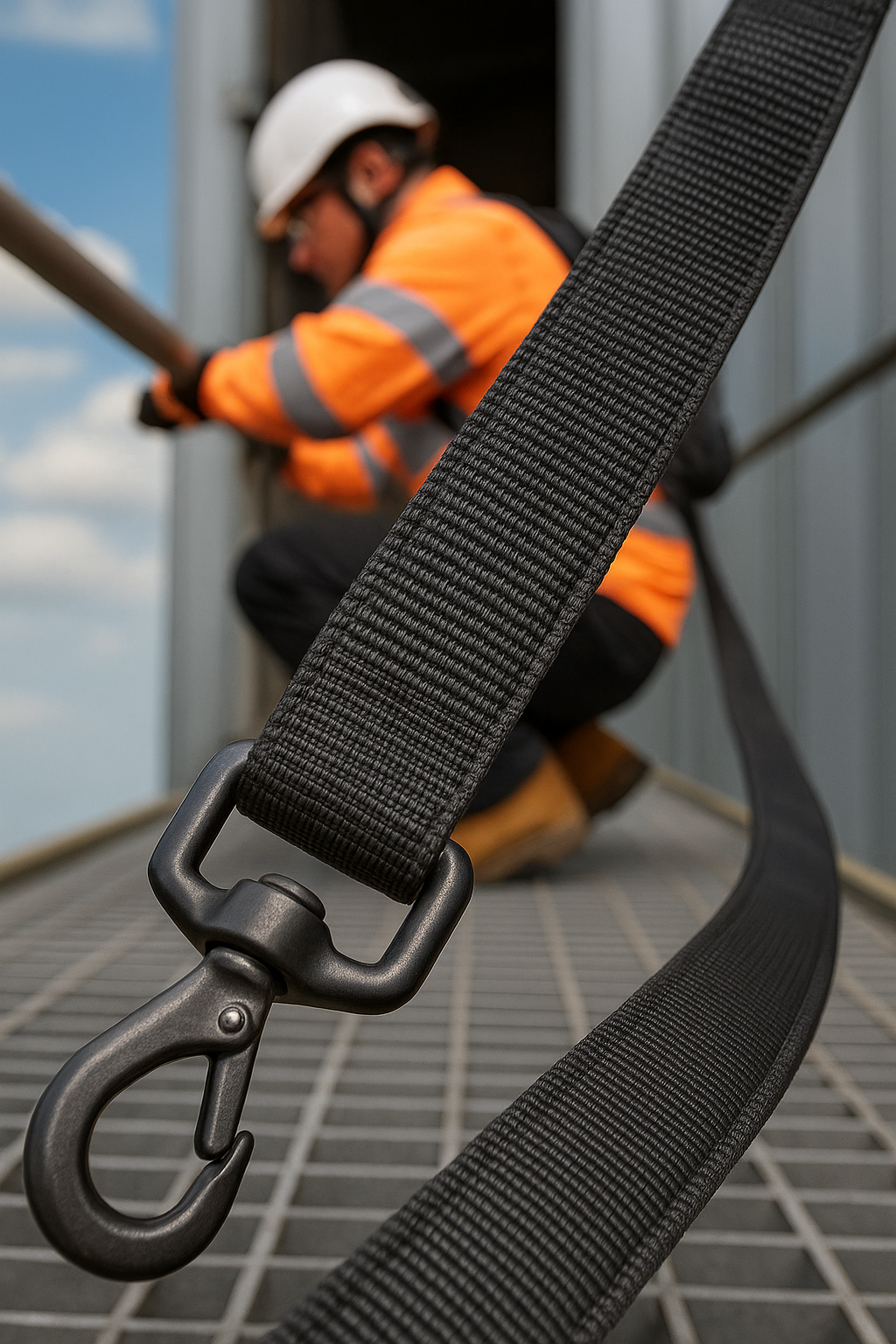
When somebody puts on a fall arrest harness, the webbing can look like one of the simplest parts of the system. In reality, it is a highly engineered, safety-critical component. Strength matters, but so do elongation, abrasion resistance, flexibility, construction, finishing and manufacturing consistency. For manufacturers of harnesses and other working-at-height equipment, material selection needs to go much further than width, colour and breaking strength.
The importance of fall protection remains clear. Provisional Health and Safety Executive figures for 2025/26 recorded 31 worker deaths following falls from height. This made falls from height the most common cause of fatal workplace injury in Great Britain during the year. It is a clear reminder that every part of a fall arrest system needs to perform reliably.
Why Webbing Matters in a Fall Arrest Harness
A safety harness relies on its webbing to perform predictably as part of a complete system. Depending on the application, manufacturers may need to consider tensile strength, elongation, abrasion resistance, flexibility and dimensional stability. They also need to understand how the material behaves after repeated use and exposure to demanding working environments.
These properties cannot always be considered separately. A webbing with a very high breaking strength is not automatically the right choice. Its behaviour under load, flexibility and interaction with buckles or adjusters also matter. The yarn, weave construction and finishing process all influence final performance. This is why safety harness webbing should be developed around the application rather than selected on strength alone.
Strength Is Only Part of the Specification
Breaking strength is one of the most obvious requirements when specifying webbing for fall arrest equipment, but it tells only part of the story. The way the textile behaves under load also matters, particularly when it forms part of a system designed to manage the forces generated during a fall.
Abrasion resistance is another important consideration. Harness webbing regularly comes into contact with buckles, adjusters, clothing, tools and working surfaces. Over time, this can place significant demands on the material. A suitable construction must provide the required strength while remaining flexible, durable and consistent throughout its intended service life.
Consistency and Traceability Matter
When a textile forms part of safety-critical PPE, manufacturing consistency becomes increasingly important. Changes in yarn, weave construction, finishing or production conditions can affect performance. Harness manufacturers therefore need confidence that material supplied today will perform consistently in future production runs.
Process control, testing and traceability all play an important role. The UK Government updated its list of designated PPE standards in August 2026, with further proposed amendments published in September. The finished product manufacturer remains responsible for compliance, but reliable material performance and supply-chain control remain important parts of the overall process.
Choosing the Right Fibre and Construction
Polyester and nylon are widely used in high-strength industrial webbing, but they offer different characteristics. Polyester can provide good strength, dimensional stability and resistance to environmental conditions. Nylon offers a different balance of flexibility, elongation and energy absorption.
More specialist applications may require technical fibres or specially engineered constructions. These can provide properties such as flame resistance, heat resistance, low creep, reduced weight or exceptional strength. The correct solution is rarely just “high-strength webbing”. It should be a construction developed around the mechanical, environmental and practical demands of the finished product.
Designing Webbing for Fall Protection Equipment
At M. Wright & Sons, we manufacture technical narrow woven fabrics for fall protection and other safety-critical markets. Our capabilities include yarn processing, narrow fabric weaving, dyeing and finishing, together with tensile testing and quality assurance. This allows us to develop webbing around specific performance requirements instead of forcing an application to suit an existing product.
Strength, controlled elongation, abrasion resistance, flexibility, colour and long-term durability can all form part of the development process. Manufacturers developing a new fall arrest harness, lanyard or industrial safety product can benefit from involving the webbing supplier at an early stage. Early collaboration helps identify the most suitable yarn, construction and finishing route before the product enters full production.
Webbing may look like one of the simplest components in a fall arrest system, but its performance depends on careful material selection, textile engineering and consistent manufacturing. In safety-critical applications, those details matter.