
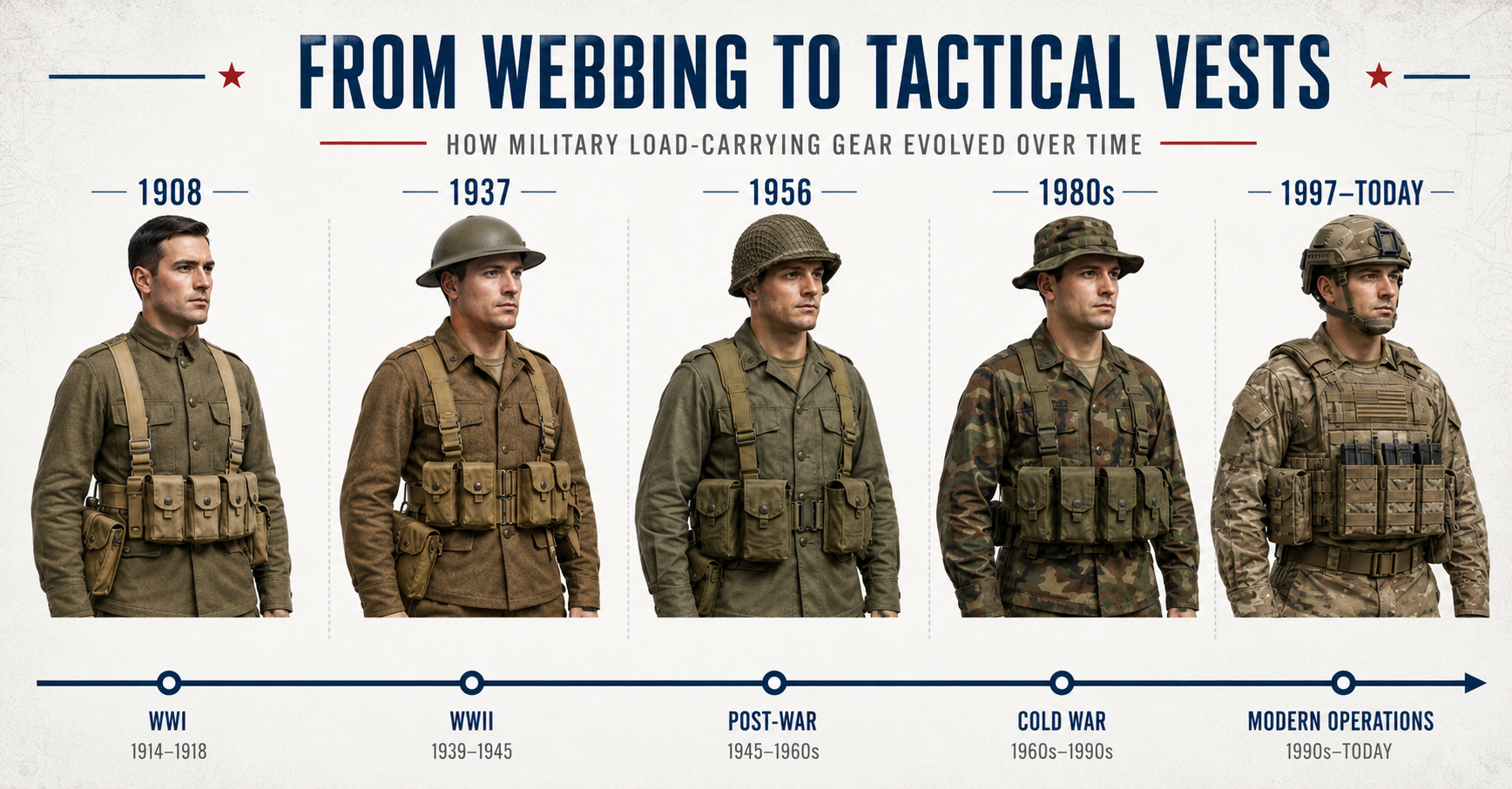
If you look at a modern soldier wearing a tactical vest or chest rig, covered in ammunition pouches, communications equipment and medical kit, it feels like a relatively modern development.
The principle behind it, however, goes back well over a century: carry essential equipment securely, distribute the load effectively and keep the soldier’s hands free.
At M Wright & Sons, that evolution is particularly interesting to us. We have been manufacturing narrow woven fabrics in Leicestershire since 1860 and strengthened our position as a supplier of military webbing in the years leading up to the First World War.
1908 – Webbing changes the battlefield
One of the major developments was the British 1908 Pattern Web Equipment.
Instead of relying heavily on leather, woven cotton webbing was used to create a connected load-carrying system for ammunition, water and personal equipment. The design distributed equipment around the body while leaving the chest relatively unrestricted – effectively an ancestor of today’s load-bearing equipment and chest rig.
By 1914, British and Commonwealth soldiers were going to war wearing webbing as a fundamental part of their equipment.
1937 – Refinement for another World War
By the Second World War, the British Army had moved to the 1937 Pattern Web Equipment, developing the same basic idea around the changing requirements of the soldier.
For companies involved in weaving military narrow fabrics, both World Wars dramatically demonstrated something we still recognise today: seemingly simple components such as straps, bindings and webbing have to perform reliably when the consequences of failure are very real.
That philosophy remains central to M Wright & Sons more than 160 years after the company was established.
Vietnam to the modern tactical vest
Post-war load carriage continued to develop. Systems increasingly moved from simple belt-and-strap arrangements towards dedicated load-bearing equipment and tactical vests.
The US military’s lightweight load-carrying systems of the Vietnam era eventually led towards systems such as ALICE – All-Purpose Lightweight Individual Carrying Equipment – and later more integrated vest-based designs.
The objective hadn’t really changed.
Carry more equipment. Make it accessible. Spread the load. Allow the wearer to move.
MOLLE changes everything
The major leap towards the tactical equipment we recognise today came with MOLLE – Modular Lightweight Load-Carrying Equipment.
Introduced by the US military in the late 1990s and increasingly widely issued in the early 2000s, MOLLE uses rows of PALS webbing that allow pouches and equipment to be positioned according to the wearer’s requirements.
Search online for a MOLLE vest – or even the commonly mistyped “mollie vest” – and you’ll see how influential that concept has become.
Modern military chest rigs, plate carriers and tactical vests now combine specialist woven webbings, technical textiles, advanced fibres, camouflage systems and modular attachment points.
Yet underneath all that technology is an idea a soldier from 1914 would immediately understand:
Strong woven fabric, positioned intelligently, carrying vital equipment where you need it.
At M Wright & Sons, we’ve been part of that wider story for generations. Today we manufacture defence-grade webbings, bindings and belts, including products designed around demanding military specifications and IRR requirements.
The equipment has changed enormously.
The importance of the webbing hasn’t.